

Excavations conducted by the Israel Antiquities Authority near Ramat Gan’s well-known Winter Stadium uncovered a planned complex with intersecting streets, shops or warehouses, pottery kilns and industrial installations. • The excavations were conducted prior to the construction of a large bus terminal at the site by Netivei Ayalon. • This coming Wednesday, August 19, the Israel Antiquities Authority will hold an open day at the site for the general public.
A 1,300-year-old planned industrial and commercial complex, with streets, pottery kilns and industrial installations, was uncovered in recent months during Israel Antiquities Authority excavations in the Winter Stadium parking lot in Ramat Gan. The excavations were conducted prior to the construction of a large bus terminal at the site by Netivei Ayalon.

Aerial view of the Israel Antiquities Authority excavation in Ramat Gan. Photo: Assaf Peretz, Israel Antiquities Authority
“Although buildings and artifacts from ancient periods have been discovered in the area in the past, the results of the current excavation exceeded all expectations,” say Dr. Yoav Arbel and Lior Rauchberger, excavation directors on behalf of the Israel Antiquities Authority. “The excavation uncovered an organized, planned complex featuring straight, intersecting streets. Lining these streets were a series of rooms that served as shops or warehouses, plastered industrial facilities, pottery kilns and more. Clearly, its main phase was planned in advance in detail by engineers and was built with the knowledge of the regional authorities — and perhaps even on their initiative and with their funding. Its location was also likely not coincidental: the site was situated near the main road that connected Jaffa, Ramla — then the district capital — and Jerusalem. Possibly, it stood on a secondary road branching off from this central route. The area also offered fertile agricultural land and available water sources.”
According to the researchers, the complex may have served as a large trade and industrial station; another possibility is that it was part of an as-yet undiscovered nearby settlement.
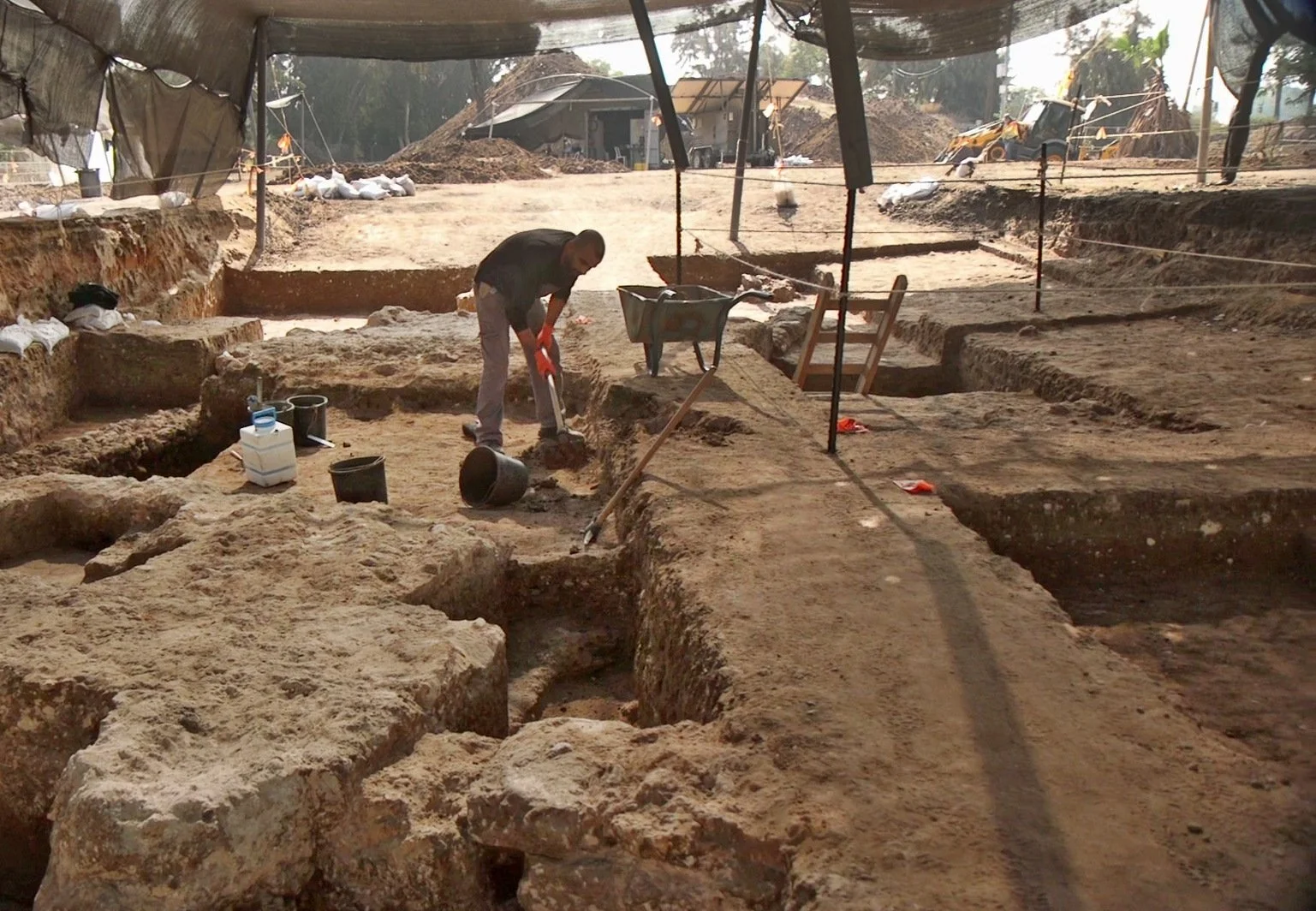
The Israel Antiquities Authority excavation adjacent to Winter Stadium. Photos: Emil Aladjem, Israel Antiquities Authority
Built in the 7th or 8th century CE, the complex operated for about 150 years before being abandoned under circumstances that remain unknown at this stage. The site was resettled in the 10th century CE. Residential buildings and production facilities were built there, and numerous tabuns — clay baking ovens — were installed. In the late 11th century CE, before the Crusader conquest, the site was abandoned once again and was never resettled.
In addition to the impressive building remains, dozens of pottery vessels and intact oil lamps were found, along with numerous bronze tableware and cosmetic implements; iron pickaxe heads, a sickle and numerous nails; dozens of coins; and a large quantity of fragments of local and imported pottery and glass vessels. Together, these finds provide a vivid reflection of the period’s culture, trade and economy.

An oil lamp uncovered in the Ramat Gan excavation. Photo: Emil Aladjem, Israel Antiquities Authority
This planned 1,300-year-old complex dates to the Umayyad and Abbasid periods, while the later residential settlement existed during the Fatimid period. The population of the Land of Israel during these periods was diverse and included Muslim, Christian, Jewish and Samaritan communities. Ramla, the district capital, had a Muslim community, while the Yarkon region was probably home to many Samaritans — descendants of a large population that flourished in the area during the Byzantine period, which preceded the Muslim conquest in the 7th century CE. However, the excavations themselves did not uncover any finds that clearly indicate the ethnic or religious identity of the local residents.
According to Minister of Heritage Rabbi Amichai Eliyahu, “The discovery of ancient finds in a residential neighborhood in Ramat Gan, adjacent to a well-known, long-standing stadium, once AAagain demonstrates the historical and archaeological wealth of the State of Israel, where windows onto distant periods of the past may open anywhere.”
This coming Wednesday, August 19, the Israel Antiquities Authority will hold an open day at the site for the general public. The finds will subsequently be covered to ensure their preservation. At the same time, the possibility of displaying some of the finds to the public in the future will be examined. Admission is by advance registration only. Further details are available at the following link: https://tinyurl.com/2ubwtvjz
Banner image: A series of rooms that served as shops or warehouses, along with industrial installations and pottery kilns, was uncovered along the streets. Photo: Emil Aladjem, Israel Antiquities Authority