
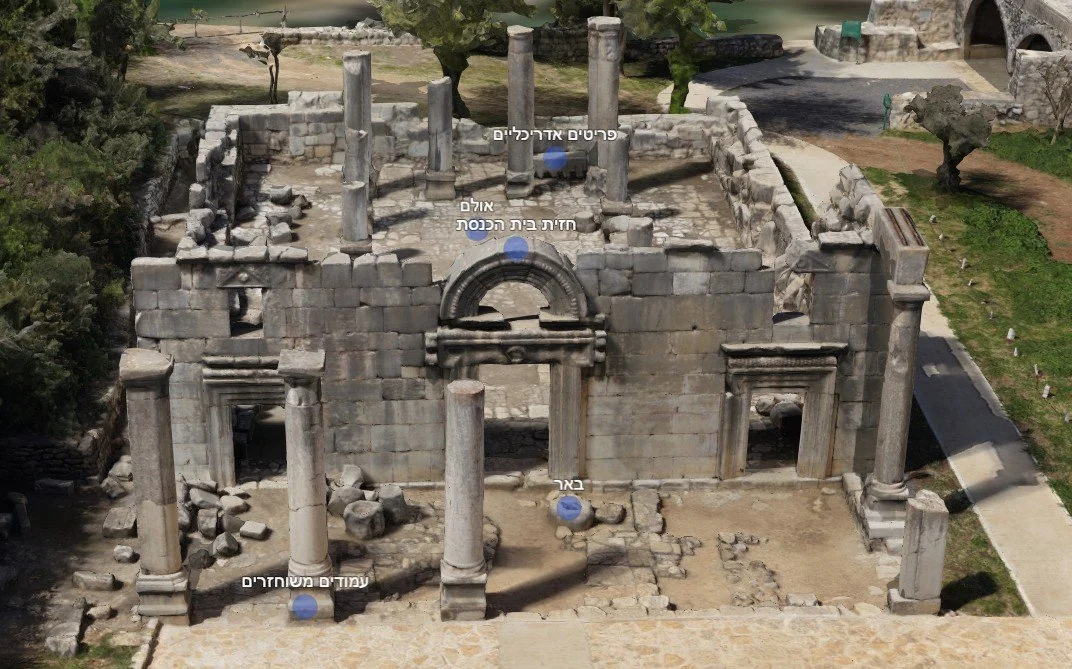
One of the largest digital archaeological databases in the world, with approximately 4 million records –with almost one million objects discovered in excavations, over one million images, 15,000 3-D models of finds and sites, and more – all now easily accessible to researchers and to the public, in Israel and the world over
The Israel Antiquities Authority launches the Israel National Archaeological Database - A groundbreaking digital platform, one of the largest of its kind in the world, centralizes all the archaeological information collected and researched in Israel. The database currently includes 3,910,005 records, alongside 964,393 objects, 1,223,552 images, 15,164 3-D models, and much more.

Gamla National Park. Model by Alexander Wiegmann. From the National Archaeology Database of the Land of Israel, Israel Antiquities Authority
Using the new database, researchers, and the general public from Israel and abroad can browse publications, photos, 3-D scans, excavation reports, archive documents and more – in a smart search by site, period, type of find and other categories.
One of the outstanding capabilities of the system is an interactive geographic search, which allows you to plot an area of interest on a map, and to immediately receive all the relevant archaeological information – from findings to excavation documents, images, models and professional publications.

An Engraved gem from Hanita (Roman period) – Can be found in the National Archaeology Database. Photo: Clara Amit, Israel Antiquities Authority
“In a country with a rich heritage like Israel, a huge collection of archaeological information from all periods has been collected over the years,” explains Alby Malka, Head of the Technologies Division at the Israel Antiquities Authority. “By Israeli law, every archaeological find that is uncovered must be reported, documented and deposited in the National Archives. As a result, data constantly gathers under the aegis of the Israel Antiquities Authority on many archaeological digs, as well as on hundreds of thousands of ancient items – from scrolls and coins to pottery, jewelry and archaic architectural elements. A national archaeological database, which gathers and makes all this knowledge accessible both to the lay public and to researchers, is a tool of paramount importance for scientific research, for preserving the country’s heritage, and for deepening public knowledge, with tools accessible and inviting to the younger generation. This database represents a real revolution. Instead of spending months physically traveling and searching in print archives and reports, any researcher anywhere in the world – and really any person, there are no restrictions – can type in a single word or mark a point on the map, and receive all the available collected information in seconds, directly into their hands. This is truly a monumental and transformative leap forward that at once puts Israel at the forefront of global archaeological research.”
Dr. Débora Sandhaus, Chief Scientist of the Israel Antiquities Authority, added, “The Israel National Archive for Archaeology is not only a treasure for Israel, but is a global asset. It gives the international scientific community unique access from any computer in the world to vast knowledge about the history of the Levant, and enables a large-scale comparative study, which was never even possible until now.”

Dr. Débora Sandhaus, Chief Scientist of the Israel Antiquities Authority. Photograph by Yoli Schwartz, Israel Antiquities Authority
According to Eli Escusido, Director of the Israel Antiquities Authority, “In an age where there is a growing need for access to reliable and well-grounded knowledge, the Israel National Archaeological Database is an expression of the Israel Antiquities Authority's commitment to transparency and professionalism. This database reflects the great wealth of archaeological research in Israel across all periods and all cultures, since this country has been a crossroads throughout human history, and we preserve and report all of it – we are the guardians of the footprint of every creed, culture and religion that ever walked though this land – that is our moral and legal mandate. The online National Archive embodies a universal, fundamental template that makes our human heritage accessible to the general public and researchers worldwide”.
Banner image: The ancient synagogue in Baram National Park. Over 15,000 models have been uploaded to the National Archaeology Database. Model by David Zell, Israel Antiquities Authority