

The statues were unearthed in an Israel Antiquities Authority archaeological excavation prior to constructing the coastal high-speed railway for the Ministry of Transportation and Israel Railways High-Speed Coastal Railway Project * “They may have decorated the villa of one of Caesarea’s wealthiest people,” say the researchers. This is a once-in-a-lifetime discovery” * The findings will be presented to the public for the first time at the Seventh Annual Central Region archaeological conference “Center VII – The Domestic House”, scheduled for June 18 at Tel Aviv’s MUZA – Eretz Israel Museum.
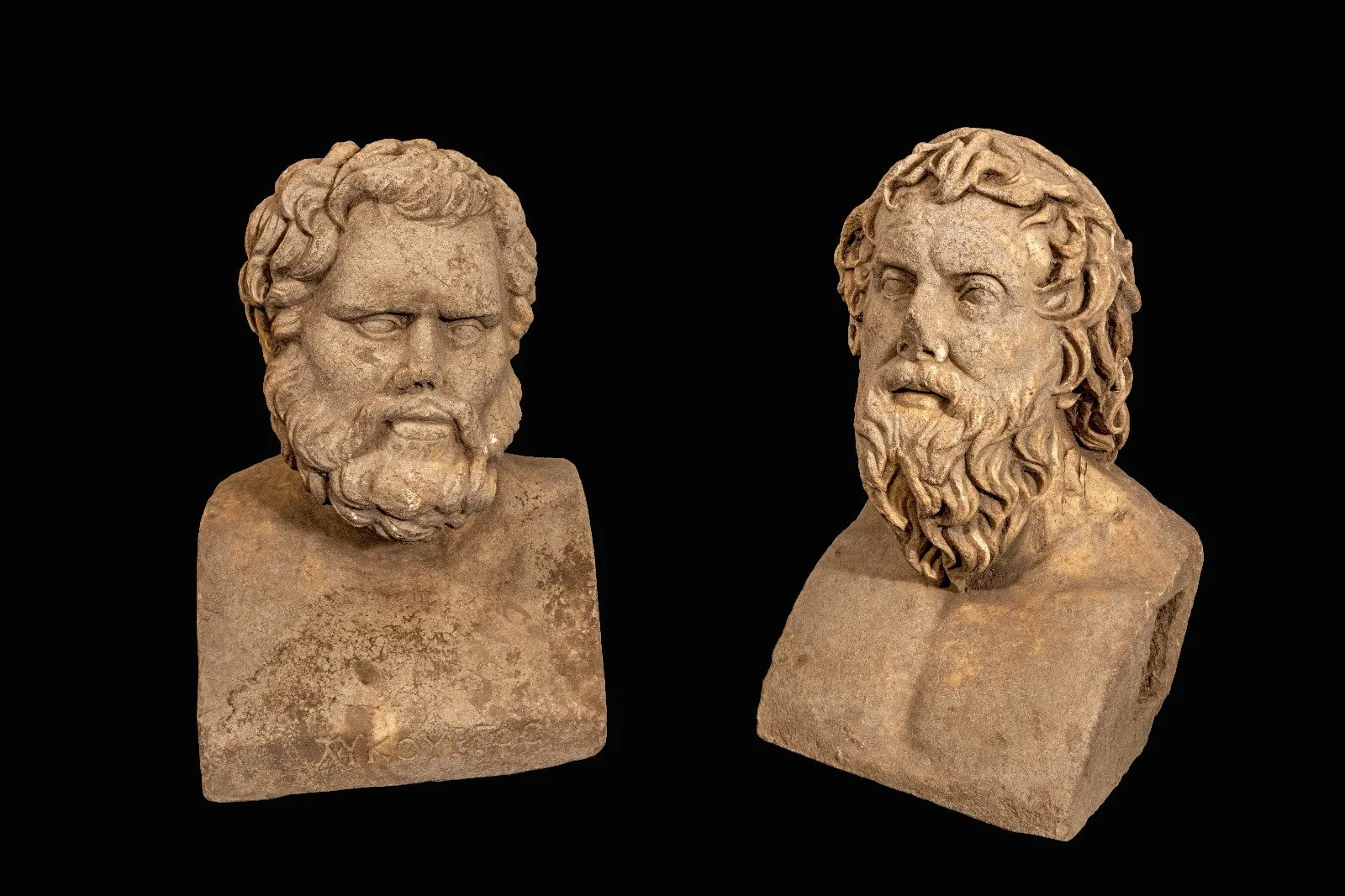
The statues uncovered by the Israel Antiquities Authority excavation. Photo: Assaf Peretz, Israel Antiquities Authority
A spectacular archaeological discovery in Binyamina: Two marble statues (protomes, human head and upper torso), approximately 1,700 years old, depicting historical figures from the Greco-Roman world, were found buried in a wine collection pit of a Roman-Byzantine winepress. A Greek inscription bearing the name “Lycurgus“ was preserved on one of the statues. The protomes were uncovered in an archaeological excavation directed by the Israel Antiquities Authority as part of the “Connecting Israel” project led by the Ministry of Transportation and Israel Railways to double the coastal rail lines (National Infrastructure Plan 65), adding high-speed 250 km/h trains that will reduce Haifa –Tel Aviv travel time to only half an hour, and thus creating the “High-Speed Coastal Railway”.
The spectacular statues will be unveiled for the first time at the “Center VII -The Domestic House” annual archaeological conference scheduled for Thursday, June 18 at Tel Aviv’s MUZA – Eretz Israel Museum, in collaboration with the Central Region of the Israel Antiquities Authority, The Sonia and Marco Nadler Institute of Archaeology at Tel Aviv University, the Institute of Archaeology of the Martin (Szusz) Department of Land of Israel Studies and Archaeology at Bar-Ilan University, and MUZA. The statues will be on public display at the museum throughout the summer months.
“The statues date back to the Roman period, and interestingly, they were not discovered in situ where they once stood! Mysteriously, they were found neatly laid, face down, inside a wine-collection pit of a Roman-Byzantine period winepress; meaning they were buried when it went out of use. At present, it is not known why the statues were hidden here – perhaps to preserve them,“ say Eliran Oren and Avishag Reiss, excavation directors on behalf of the Israel Antiquities Authority.
"While digging the winepress, something was sticking out of the ground, and the workers called me,” says Michael Sorotskin, archaeologist for the Israel Antiquities Authority. “There was a feeling that we were about to discover something that really shouldn't be there. Suddenly we saw that this was not the usual pottery – it was marble! Then, slowly, slowly, the two statues were revealed. I'm still struggling to find the right words. It is simply wondrous.”
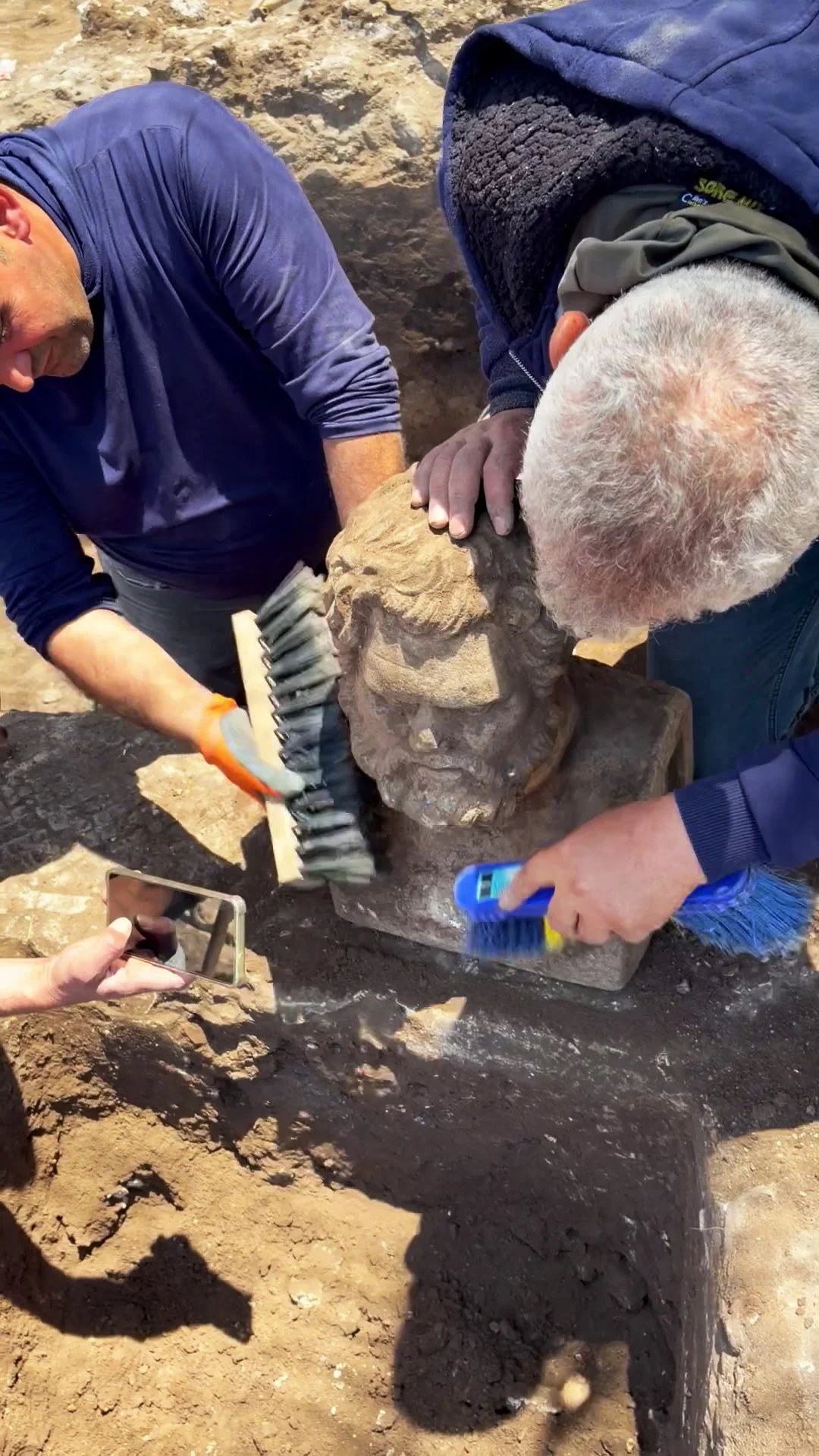
Cleaning a statue after its discovery. Photo: Eliran Oren, Israel Antiquities Authority
“This is a once-in-a-lifetime discovery,” add the excavation directors, Oren and Reiss. “It was very unexpected, but somehow, the really big discoveries always turn up on the excavation’s very last day.”
According to Dr. Peter Gendelman, a Caesarea region expert from the Israel Antiquities Authority, “These statues now join a series of historical figure portraits previously discovered in Caesarea. The last time such a figure was discovered here was in the 1990s. One protome bears a Greek inscription preserving the name of Lycurgus. Two significant people with this name are known from Greek history – Lycurgus of Sparta, its founder; and Lycurgus of Athens, a famed 4th century BCE statesman and orator. Possibly this statue may prove to be of one of these two historical figures, but our research is just beginning.”
Dr. Gendelman adds, “During the Roman period, statues of this type were displayed both in public buildings and in the homes of the elite, who sought to connect themselves to the cultural and spiritual world of antiquity. Not far from the discovery site, remains of a bathhouse were previously uncovered, and it is possible that the statues decorated a luxurious villa of a Caesarea resident.”
After their initial public display, the statues will undergo a process of cleaning, conservation, and further research, during which scholars will attempt to identify with certainty whom they depict, and the exact ancient context in which they were originally placed.

One of the statues during initial conservation treatment in the Israel Antiquities Authority laboratories. Photo: Emil Aladjem, Israel Antiquities Authority
According to Gil Omer, Director General of MUZA – Eretz Israel Museum, Tel Aviv: “It is not every day that 1,700-year-old marble statues are uncovered in such an impressive state of preservation. We are proud to be the place where the public will be able to encounter this extraordinary discovery for the first time, and to continue seeing it after the conference as well. Presenting the statues in MUZA’s Ceramics Pavilion is a rare opportunity to introduce visitors to an exceptional archaeological find shortly after its discovery, and to connect them with a fascinating story.”

From top to bottom – archaeologists Eliran Oren, Avishag Reiss and Michael Sorotskin from the Israel Antiquities Authority. Photo: Nohar Shahar, Israel Antiquities Authority
Yelena Elgart-Sharon, Curator of the Ceramics Pavilion at MUZA: “The statues recently uncovered in the Israel Antiquities Authority excavation near Binyamina offer the public a rare opportunity to take part in the process of revealing the past almost in real time. We are proud to host and display this unique find at MUZA shortly after its discovery. The display, together with the ‘In Centro’ conference that will take place at the museum on June 18 in partnership with the Israel Antiquities Authority, reflects the ongoing collaboration between the two institutions and their shared commitment to making archaeology accessible to the public.”
Israeli Minister of Heritage Rabbi Amichai Eliyahu shares: “This revelation is the kind of discovery that demonstrates to the public the power of archaeology – one moment we are working on a modern infrastructure project, and the next moment a window opens into the lives and cultural world of those who lived right here many hundreds of years ago. The role of the State of Israel is to preserve these findings of all cultures, research them, and make them accessible to the public – so that everyone can encounter and form their own close-up impressions of our country’s rich and broad past.”
The magnificent sculptures’ initial public presentation at the seventh annual “In the Center” archaeological conference, in the context of this year’s theme, the domestic house. The conference will take place on Thursday, June 18, 2026, at MUZA, the Eretz Israel Museum in Tel Aviv. The conference is the product of cooperation between Israel Antiquities Authority Central Region, the Sonia and Marco Nadler Institute of Archaeology at Tel Aviv University, and the Institute of Archaeology of the Martin (Szusz) Department of Land of Israel Studies and Archaeology at Bar-Ilan University, and MUZA n Tel Aviv. Conference attendance is free of charge.
Banner image: Archaeologists Eliran Oren and Michael Sorotskin with the statues discovered in Binyamina. Photo: Yoli Schwartz, Israel Antiquities Authority